top of page


A Dream Come True
Distinguished Professor of English Jason Miller screens his film, Origin of the Dream. From NC State Magazine by Chris Saunders In 2013, Distinguished Professor of English Jason Miller discovered an audio reel with a hidden history. Long forgotten in a Rocky Mount, N.C., library was a recording of a November 1962 speech Martin Luther King Jr. delivered at Rocky Mount’s Booker T. Washington High School. Read more ...
Jun 291 min read


NC State professor's film reveals MLK's iconic 'I Have A Dream' speech has origins in Rocky Mount
By Ken Smith From WRAL News In celebration of Black History Month, a new documentary from an NC State professor explores the inspiration behind Dr. Martin Luther King Jr.’s iconic “I Have a Dream” speech. Through his research, Jason Miller found that King first uttered that historic refrain at a gym in Rocky Mount—nine months before the March on Washington. Read More...
Feb 271 min read


“Origin of the Dream” film by NC State professor adds depth, historical context to MLK’s time in NC
By Damien Reed From The Technician The film “Origin of the Dream” was screened in the James B. Hunt Jr. Library Auditorium on Thursday, Jan. 22 as a part of MLK Commemoration Week, shedding light on North Carolina’s role in the Civil Rights Movement and the long-term impact Martin Luther King Jr. made on those that heard him speak. The film was created by Jason Miller, a distinguished professor, in collaboration with Emmy-award winning filmmaker Neal Hutcheson and featured ma
Feb 51 min read
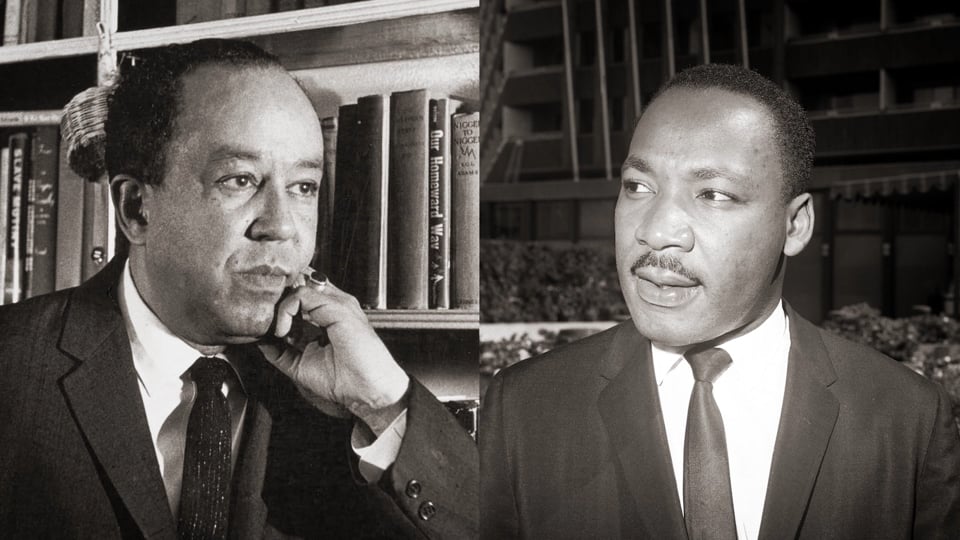
Origin of the Dream — How Langston Hughes inspired Martin Luther King, Jr.
Source: PBS Documentary on Vimeo This hour-long documentary was researched by Jason Miller, and produced by Rebecca Cerese and Emmy Award-winner Neal Hutcheson. It traces King's first use of "I Have a Dream" in Rocky Mount, NC (November 27, 1962) and documents how Langston Hughes's poetry inspired King's dream metaphor. The documentary features Danny Glover, Ambassador Andrew Young, Rev. William Barber II, David Garrow, and the final on-camera interview with Julian Bond. Surv
Jan 221 min read


Stanford's Dr. Lerone Martin & NC State's Dr. Jason Miller on MLK's Dream & Langston Hughes's Poetry
From The Learning Curve Podcast (Pioneer Institute) In this Martin Luther King, Jr. Day episode of The Learning Curve , co-hosts U-Ark Prof. Albert Cheng and Alisha Searcy of the Center for Public Schools speak with Dr. Lerone Martin , Martin Luther King, Jr. Centennial Professor at Stanford University, and Dr. Jason Miller , Distinguished Professor of English at North Carolina State University. They explore the religious, literary, and historical foundations of MLK’s thoug
Jan 191 min read


Podcast: The Origin of MLK Jr.’s ‘ I Have a Dream’ Speech
By Tracey Peake From NC State University News Jason Miller joins us to talk about the full-length documentary he’s produced on the origin and evolution of Martin Luther King, Jr.’s most famous speech. Most people associate King’s most famous refrain, “I have a dream,” with the speech he gave at the March on Washington in 1963. Miller’s documentary explores King’s first recorded usage of that phrase, which occurred in Rocky Mount, NC in 1962. Listen Here
Jan 61 min read


Finding King’s Speech: English Professor’s Research Uncovers Historic Recording
By Lauren Kirkpatrik From NC State University News For years, Rocky Mount citizens have told tales about hearing the first rendition of Martin Luther King Jr.’s “I have a dream” speech. Before 1,800 people in a crammed high school gym, King talked about his “dream” and uttered other familiar passages in the fall of 1962. It was nine months before the March on Washington. More than 50 years later, an NC State English professor’s research is bringing that same speech back to li
Aug 12, 20251 min read


MLK’s First Dream
By Jason Miller From NC State University News Dr. Martin Luther King, Jr. first delivered the now famous refrain “I have a dream” in Rocky Mount, N.C., on Nov. 27, 1962. Dr. King ended his fifty-five minute speech in the Booker T. Washington Gymnasium by invoking the “How Long, Not Long” set-piece he made famous when he spoke from the steps of the capital at the end of the final march in Selma, Alabama on March 25, 1965. He then continued with eight consecutive lines of “I ha
Aug 11, 20251 min read


Martin Luther King Jr.'s first 'I Have a Dream' speech was delivered in N.C.
By Sydney McCoy From Spectrum News 1 “I Have a Dream,” echoing with King’s powerful call for equality, remains one of history’s most acclaimed speeches, its message still resonating globally. While frequently studied in English classes and seen as a cornerstone of the civil rights movement, King’s speech debuted in Rocky Mount, North Carolina. W. Jason Miller, a distinguished professor in the English Department of N.C. State, shares something in common with King — a love of
Jan 20, 20251 min read
Langston Hughes and the Rev. Dr. Martin Luther King, Jr.
By Michael Morand From Yale Beinecke Library echibit on Hughes and King “For years, Martin Luther King Jr. and poet Langston Hughes maintained a friendship,” Jason W. Miller of North Carolina State University noted in Smithsonian Magazine in 2018 . The Langston Hughes Papers are a great source about the relationship between Hughes and King and were a key source for Miller’s 2015 book, Origins of the Dream: Hughes’s Poetry and King’s Rhetoric . This temporary display showcase
Jan 9, 20231 min read
"Kings Speech" - Smithsonian Sidedoor Podcast
From Smithsonian Dr. Martin Luther King Jr.'s "I Have a Dream" speech at the 1963 March on Washington is one of the most famous speeches in the world. But it almost didn't happen. If you look at the typed manuscript of his speech, you won't find the phrase "I Have a Dream." But even though Dr. King's speech was partially improvised, that doesn't mean that it wasn't years in the making. In this episode of Sidedoor, we trace the evolution of King's dream, from a secret friendsh
Feb 9, 20221 min read


Langston Hughes' hidden influence on MLK
From The Conversation Martin Luther King Jr.’s dream – which alternated between shattered and hopeful – can be traced back to Hughes’ poetry. AP Photo For years, Martin Luther King Jr. and poet Langston Hughes maintained a friendship, exchanging letters and favors and even traveling to Nigeria together in 1960. In 1956, King recited Hughes’ poem “Mother to Son” from the pulpit to honor his wife Coretta, who was celebrating her first Mother’s Day. That same year, Hughes wrote
Mar 30, 20181 min read
Experiencing King from New Angles
By Nash Dunn From NC State University News Martin Luther King Jr.’s speeches help form the foundation of his legacy. From “I have a dream” to “Fill up the jails,” his words are timeless. Echoing from old recordings and jumping off the page of the written record, King’s ideas and rhetoric pillared the civil rights movement, and they continue to inform and instruct leaders as they navigate current social challenges. They’re still used by teachers to educate students — still use
Jan 13, 20161 min read
bottom of page