top of page


A Dream Come True
Distinguished Professor of English Jason Miller screens his film, Origin of the Dream. From NC State Magazine by Chris Saunders In 2013, Distinguished Professor of English Jason Miller discovered an audio reel with a hidden history. Long forgotten in a Rocky Mount, N.C., library was a recording of a November 1962 speech Martin Luther King Jr. delivered at Rocky Mount’s Booker T. Washington High School. Read more ...
Jun 291 min read


NC State professor's film reveals MLK's iconic 'I Have A Dream' speech has origins in Rocky Mount
By Ken Smith From WRAL News In celebration of Black History Month, a new documentary from an NC State professor explores the inspiration behind Dr. Martin Luther King Jr.’s iconic “I Have a Dream” speech. Through his research, Jason Miller found that King first uttered that historic refrain at a gym in Rocky Mount—nine months before the March on Washington. Read More...
Feb 271 min read


“Origin of the Dream” film by NC State professor adds depth, historical context to MLK’s time in NC
By Damien Reed From The Technician The film “Origin of the Dream” was screened in the James B. Hunt Jr. Library Auditorium on Thursday, Jan. 22 as a part of MLK Commemoration Week, shedding light on North Carolina’s role in the Civil Rights Movement and the long-term impact Martin Luther King Jr. made on those that heard him speak. The film was created by Jason Miller, a distinguished professor, in collaboration with Emmy-award winning filmmaker Neal Hutcheson and featured ma
Feb 51 min read
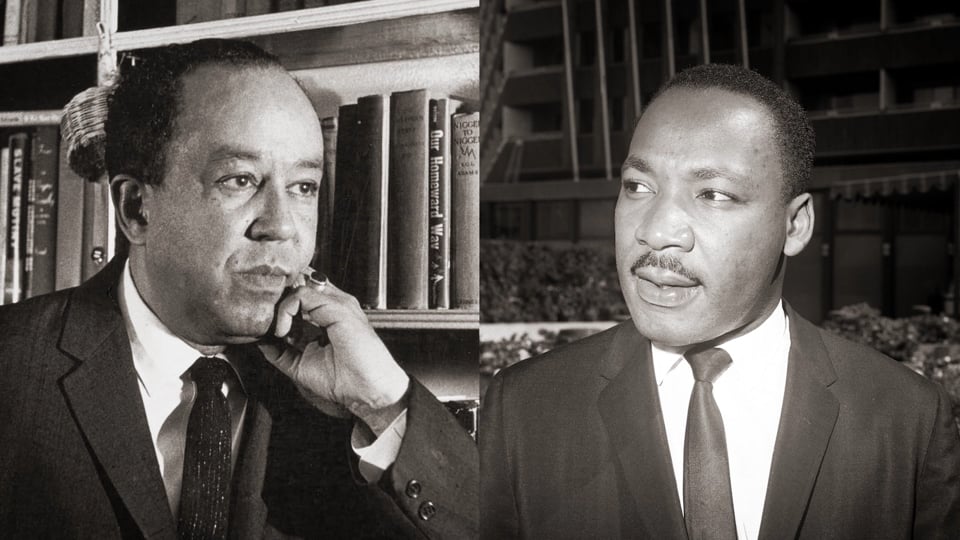
Origin of the Dream — How Langston Hughes inspired Martin Luther King, Jr.
Source: PBS Documentary on Vimeo This hour-long documentary was researched by Jason Miller, and produced by Rebecca Cerese and Emmy Award-winner Neal Hutcheson. It traces King's first use of "I Have a Dream" in Rocky Mount, NC (November 27, 1962) and documents how Langston Hughes's poetry inspired King's dream metaphor. The documentary features Danny Glover, Ambassador Andrew Young, Rev. William Barber II, David Garrow, and the final on-camera interview with Julian Bond. Surv
Jan 221 min read


Stanford's Dr. Lerone Martin & NC State's Dr. Jason Miller on MLK's Dream & Langston Hughes's Poetry
From The Learning Curve Podcast (Pioneer Institute) In this Martin Luther King, Jr. Day episode of The Learning Curve , co-hosts U-Ark Prof. Albert Cheng and Alisha Searcy of the Center for Public Schools speak with Dr. Lerone Martin , Martin Luther King, Jr. Centennial Professor at Stanford University, and Dr. Jason Miller , Distinguished Professor of English at North Carolina State University. They explore the religious, literary, and historical foundations of MLK’s thoug
Jan 191 min read


Podcast: The Origin of MLK Jr.’s ‘ I Have a Dream’ Speech
By Tracey Peake From NC State University News Jason Miller joins us to talk about the full-length documentary he’s produced on the origin and evolution of Martin Luther King, Jr.’s most famous speech. Most people associate King’s most famous refrain, “I have a dream,” with the speech he gave at the March on Washington in 1963. Miller’s documentary explores King’s first recorded usage of that phrase, which occurred in Rocky Mount, NC in 1962. Listen Here
Jan 61 min read


How the Poetry of Langston Hughes Inspired Martin Luther King’s First Dream
By UF Press Martin Luther King, Jr. first spoke of “dreams” in a sermon he delivered on April 5, 1959. His subject that day was disappointment, not hope. The focus of his sermon came when he said: “Very few people are privileged to live life with all of their dreams realized and all of their hopes fulfilled. Who here this morning has not had to face the agony of blasted hopes and shattered dreams?” Though it doesn’t flash on first glance, King’s reference to unfulfilled and
Oct 20, 20251 min read


Finding King’s Speech: English Professor’s Research Uncovers Historic Recording
By Lauren Kirkpatrik From NC State University News For years, Rocky Mount citizens have told tales about hearing the first rendition of Martin Luther King Jr.’s “I have a dream” speech. Before 1,800 people in a crammed high school gym, King talked about his “dream” and uttered other familiar passages in the fall of 1962. It was nine months before the March on Washington. More than 50 years later, an NC State English professor’s research is bringing that same speech back to li
Aug 12, 20251 min read


MLK’s First Dream
By Jason Miller From NC State University News Dr. Martin Luther King, Jr. first delivered the now famous refrain “I have a dream” in Rocky Mount, N.C., on Nov. 27, 1962. Dr. King ended his fifty-five minute speech in the Booker T. Washington Gymnasium by invoking the “How Long, Not Long” set-piece he made famous when he spoke from the steps of the capital at the end of the final march in Selma, Alabama on March 25, 1965. He then continued with eight consecutive lines of “I ha
Aug 11, 20251 min read


MLK deplored violence like Raleigh’s in ‘68. Leaders now can learn from that
By Jason Miller From The News & Observer Rev. Douglas Moore, pastor of the Asbury Temple Methodist Church, Dr. Martin Luther King Jr., Rev. Ralph Abernathy and NCCU student Lacy Streeter walk along West Main Street on their way to the Woolworth Lunch Counter in this file photo from Feb. 16, 1960. Read more at: https://www.newsobserver.com/opinion/article298682198.html#storylink=cpy With the unique 2025 overlap of Martin Luther King Day and the Inauguration of Donald Trump, Am
Jan 20, 20251 min read


Martin Luther King Jr.'s first 'I Have a Dream' speech was delivered in N.C.
By Sydney McCoy From Spectrum News 1 “I Have a Dream,” echoing with King’s powerful call for equality, remains one of history’s most acclaimed speeches, its message still resonating globally. While frequently studied in English classes and seen as a cornerstone of the civil rights movement, King’s speech debuted in Rocky Mount, North Carolina. W. Jason Miller, a distinguished professor in the English Department of N.C. State, shares something in common with King — a love of
Jan 20, 20251 min read


WKNC 88.1 FM — Campus radio interview
From WKNC 88.1 Alumni Distinguished Undergraduate Professor Dr. Jason Miller is renowned for his research on, and discoveries about, Langston Hughes, Dr. Martin Luther King, and Nina Simone. Of particular note is his discovery of the first ever recording of Dr. Martin Luther King’s “I Have a Dream” speech. In this episode, Dr. Miller discusses his unconventional path to becoming a professor, his research, and his research process. I really enjoyed this conversation and gettin
Oct 16, 20241 min read


F.B. Eyes on Langston Hughes and Martin Luther King, Jr.
From National Humanities Center Dr. King’s iconic refrain “I Have a Dream” was actually first delivered in Rocky Mount, NC, nine months before the March on Washington in 1963. By listening to this long lost reel-to-reel audio tape from November of 1962, we discover how this phrase actually has its origins in the poetry of Langston Hughes (1901–67). While Hughes was harassed by the FBI from as early as 1941, King’s every movement was traced, photographed, recorded, and even fi
Feb 20, 20241 min read


The King’s Speech: When MLK Visited NC State’s Campus
By Ayn-Monique Klahre From Walter Magazine On July 31, 1966, Dr. Martin Luther King Jr. spoke at Reynolds Coliseum on the campus of North Carolina State University. A crowd of 4,000 — described by The News & Observer as“3,000 Negroes and 1,000 white persons” — gathered to hear him speak. King’s visit was sponsored by the Martin Luther King Forum, described by the paper as “a local ad hoc committee served by Romallus O. Murphy and the Rev. W. B. Lewis, as co-chairmen.” Ira Har
Jan 1, 20241 min read
Langston Hughes and the Rev. Dr. Martin Luther King, Jr.
By Michael Morand From Yale Beinecke Library echibit on Hughes and King “For years, Martin Luther King Jr. and poet Langston Hughes maintained a friendship,” Jason W. Miller of North Carolina State University noted in Smithsonian Magazine in 2018 . The Langston Hughes Papers are a great source about the relationship between Hughes and King and were a key source for Miller’s 2015 book, Origins of the Dream: Hughes’s Poetry and King’s Rhetoric . This temporary display showcase
Jan 9, 20231 min read
"Kings Speech" - Smithsonian Sidedoor Podcast
From Smithsonian Dr. Martin Luther King Jr.'s "I Have a Dream" speech at the 1963 March on Washington is one of the most famous speeches in the world. But it almost didn't happen. If you look at the typed manuscript of his speech, you won't find the phrase "I Have a Dream." But even though Dr. King's speech was partially improvised, that doesn't mean that it wasn't years in the making. In this episode of Sidedoor, we trace the evolution of King's dream, from a secret friendsh
Feb 9, 20221 min read


The Moments of Truth: English professor Jason Miller has a knack for unveiling the hidden past to focus on the present.
By Chris Saunders From NC State Magazine It doesn’t take long talking to NC State English professor Jason Miller to understand that for him, everything begins and ends with 20th century American poet Langston Hughes. “I was drawn to Hughes’ accessibility,” Miller says of a leader of the Harlem Renaissance movement in the 1920s and ’30s. “Here is somebody with some profound thoughts that aren’t very nuanced or so ambiguous that they’re really hard to tease out.” Read More...
Dec 16, 20211 min read
The Civil Rights Activist so Close to Martin Luther King Jr. She Was Thought of as His ‘Other Wife’
By Jason Miller From The Conversation In a 2019 article published in Standpoint Magazine, Pulitzer Prize-winning Martin Luther King Jr. biographer David Garrow detailed new information about King he discovered in FBI documents. The most damaging is that King may have witnessed – and encouraged – a sexual assault at a Washington, D.C. hotel in January 1964. Some historians have cautioned against taking too much stock of Garrow’s findings; the FBI, after all, has a well-known
Jun 24, 20191 min read
I'm an MLK scholar – and I'll never be able to view King in the same light
By Jason Miller From The Conversation David Garrow , the Pulitzer Prize-winning biographer of Martin Luther King Jr., has unearthed information that may forever change King’s legacy. In an 8,000-word article published in the British periodical Standpoint Magazine on May 30, 2019, Garrow details the contents of FBI memos he discovered after spending weeks sifting through more than 54,000 documents located on the National Archive’s website . Initially sealed by court order unt
May 30, 20191 min read


When MLK and the KKK met in Raleigh
By Jason Miller From The News & Observer Nearly forgotten, Dr. King spoke in Raleigh to an integrated audience of about 5,000 at Reynolds Coliseum at 4 p.m. on July 31, 1966. A counter-protest began two hours earlier with speeches at Memorial Auditorium and continued with a march by members from two factions of the Ku Klux Klan. FBI files reveal these white supremacists had to reschedule their rally when King’s visit was postponed from July 10 due to his involvement in protes
Feb 4, 20191 min read
bottom of page